
Deconstruction and Reconstruction
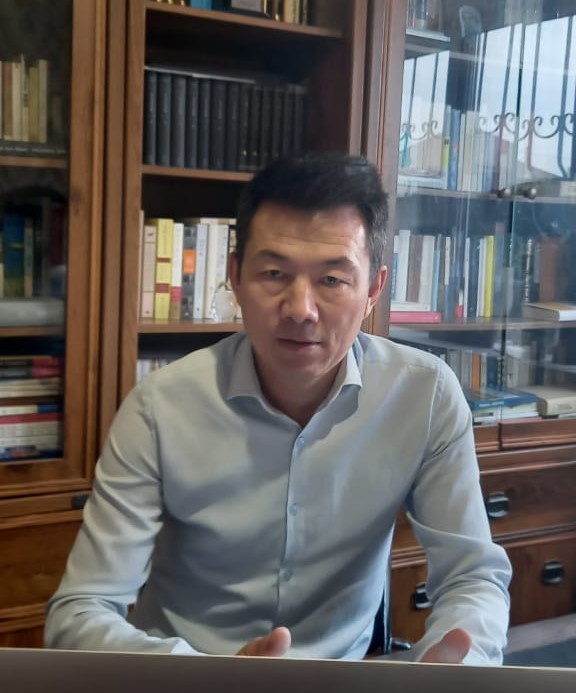
Deconstruction and Reconstruction: The Dual Poetic Structure of Modernism and Postmodernism in the Poetry of Ardakh Nurgaz 1. Ardakh Nurgaz’s “Lyrical Epic”: His Place in World Literature and a Comparison with Western Postmodern Long Poems A Comparative Study of Modern Kazakh Poetics, Postmodern Long Poetry, and Transcivilizational Literary Forms I. Establishing the Literary Coordinates: Where Does Ardakh Nurgaz Stand? Ardakh Nurgaz (also rendered as Ardakh Nurgaz, born in China in 1972) is a contemporary Kazakh-language poet distinguished by his pronounced modernist and experimental tendencies. He is also a literary critic, playwright, and participant in literary translation. An important feature of his literary identity is its intercultural dimension. Born and raised in a Kazakh cultural environment in China, he moved to Kazakhstan in 2004. His writing therefore occupies the intersection of several cultural systems: - The oral epic tradition of the Kazakh steppe, philosophical poetry, and collective historical memory. - The tradition of classical Chinese poetry, including its imagery and conceptions of time and space. - The formal experiments of European modernist and postmodernist poetry. - The fractures of identity, historical trauma, and cultural reconstruction in the post-Soviet era. The literary critic Kanat Omar has observed that Nurgaz’s poetry combines the chivalric spirit of traditional steppe poetry, the Chinese poetic tradition, and the experimental impulses of contemporary world literature. He is also regarded as an important figure in introducing Western modernist poets such as T. S. Eliot and Ezra Pound to younger Kazakh poets. Therefore, I believe the most productive starting point for understanding Nurgaz is not to place him merely on the periphery of Western postmodernism, but to regard him as a modern poetic practitioner with an independent cultural foundation. He seeks to use the cultural memory of Kazakh poetry to revisit one of the central questions confronting modern long poetry since the twentieth century: When grand narratives have disintegrated, can poetry still recover the scale and scope of the epic? This is precisely what makes his concept of the “lyrical epic” particularly worthy of study. II. The Lyrical Epic: From Grand Narrative to a Microcosm Nurgaz has articulated his poetic philosophy with considerable clarity. In discussing Wind on the Cliff and Qorkut, he introduces an important concept: New Epic. His point is that an epic does not necessarily require the enormous length, continuous narrative, or heroic protagonists associated with traditional epics. Modern poetry can create an epic atmosphere and a sense of totality through lyrical forms. He even proposes an aesthetic ideal that is particularly revealing: > To reveal the entire ocean through a single drop of water. He traces this creative approach to the poetic explorations of W. B. Yeats and Paul Celan, referring in particular to the poetic possibilities embodied in Celan’s Stretto (Engführung). It is worth noting that both Wind on the Cliff and Qorkut, as he describes them, are fewer than one hundred lines long. Yet they seek to encompass an understanding of the world extending from antiquity to the modern age. This means that his lyrical epic is not simply a reduced version of the traditional epic. It represents a structural transformation: Traditional Epic National history → Heroic action → Collective destiny → Historical resolution Modern Lyrical Epic Individual consciousness → Historical memory → Symbolic imagery → Civilizational experience Nurgaz’s New Epic Microcosmic imagery → Layered temporality → Cultural memory → The search for wholeness in a fragmented world A fundamental distinction emerges here: Traditional epics establish wholeness by narrating history; Nurgaz, by contrast, seeks to rediscover wholeness through the historical strata embedded within lyrical consciousness. In other words, the epic is no longer primarily a story. It becomes a form of world-consciousness. This gives his poetics the potential to transcend the boundaries of lyric poetry in its conventional sense. III. A Deeper Comparison with Western Modernist and Postmodern Long Poetry A distinction in literary history is necessary at the outset. T. S. Eliot’s The Waste Land and Ezra Pound’s The Cantos belong primarily to the modernist tradition of long poetry. John Ashbery’s Self-Portrait in a Convex Mirror and Flow Chart, on the other hand, are more closely associated with the openness, fragmentation, and linguistic experimentation of postwar postmodern poetry. To classify all these works simply as postmodern long poems would obscure important differences between modernism and postmodernism. I propose examining Nurgaz through five major Western poetic reference points. 1. T. S. Eliot’s The Waste Land: Civilizational Ruins and Historical Consciousness T. S. Eliot: The Waste Land (1922) The central question: After the decline of civilization, can cultural memory still sustain spiritual order? There are structural similarities worth exploring between Eliot’s The Waste Land and Nurgaz’s Sayabaq (also translated as The Park or A Garden of Trees). Eliot constructs a symbolic landscape of civilizational disorder through classical mythology, religious texts, modern urban experience, and quotations in multiple languages. Nurgaz’s A Garden of Trees: Meditations on the Postmodern Wars, meanwhile, brings war, history, civilization, memory, and individual consciousness into a single poetic space. Their similarities include: - Neither is satisfied with the expression of private emotions; both seek to expand individual consciousness into civilizational consciousness. - Both use historical allusions and cultural memory to disrupt a single, linear conception of time. - Both employ fragmented forms to represent the spiritual crisis of the modern world. Yet their fundamental differences are even more significant. | Dimension | Eliot | Nurgaz | | --- | --- | --- | | Historical consciousness | The rupture of European civilizational traditions | The collision of multiple civilizations and historical layers | | Principal structure | Mythic frameworks and quotation-based montage | The interweaving of lyrical imagery and historical fragments | | Spiritual aspiration | The search for a lost order | The search for a new sense of wholeness within fragmentation | | Cultural foundation | The European classical tradition | Kazakh, Chinese, and broader world literary memories | Eliot still tends to employ mythic structures to seek a form of order amid modern chaos. Nurgaz, by contrast, is more inclined to leave that order unfinished. This suggests that while The Waste Land organizes ruins through civilizational memory, Nurgaz tends to make the ruins themselves a medium through which civilization can be reconsidered. In interviews, Nurgaz has explicitly stated that he greatly admired Eliot in his youth, particularly his historical consciousness. 2. Ezra Pound’s The Cantos: Epic Structure and the Reorganization of Civilizational Knowledge Ezra Pound: The Cantos The central question: Can poetry contain the totality of human civilizational knowledge? Pound’s The Cantos is one of the most significant experiments in the history of modern long poetry. Rather than narrating the complete story of a hero in the manner of a traditional epic, it incorporates Chinese history, Greek mythology, economic thought, political history, literary allusions, and personal experience into an enormous textual structure. The similarities between Nurgaz and Pound are evident in three principal respects. First, the epic is no longer equivalent to a story. Traditional epics depend on characters and events to drive their narratives. Pound and Nurgaz, however, both attempt to establish epic dimensions through knowledge, symbolism, and historical fragments. Second, civilization can be represented through juxtaposition rather than continuous narration. In Nurgaz’s A Garden of Trees, historical figures, civilizational symbols, religious imagery, and modern technologies of warfare collectively form a composite world. Third, the poet assumes the role of an organizer of civilizational memory. Nevertheless, the differences between the two are equally significant: - Pound attempts to construct a system of civilizational knowledge characterized by a powerful organizing will. - Nurgaz places greater emphasis on historical rupture, the drifting of consciousness, and the instability of memory. - The epic scale of Pound’s work derives primarily from the breadth of its knowledge and historical references. - The epic quality of Nurgaz’s poetry derives from the historical density carried by microcosmic images. The distinction can be summarized as follows: Pound attempts to organize the world into a poem, whereas Nurgaz seeks the wholeness of poetry precisely where the world resists organization. 3. John Ashbery: The Open Structure of the Postmodern Long Poem John Ashbery: Self-Portrait in a Convex Mirror (1975) and Flow Chart (1991) The central question: How can poetry continue to exist when language no longer provides stable meaning? Ashbery is one of the most valuable points of comparison for understanding Nurgaz’s postmodern poetics. Ashbery’s major contribution lies in liberating poetry from conventional logical progression, thematic development, and the expectation of definitive conclusions. In his poetry: - Consciousness can constantly change direction. - Language can generate new meanings through association. - The narrative subject is not always stable. - Poetry can remain open without providing explicit answers. Nurgaz’s A Garden of Trees similarly employs nonlinear structures, dreamlike logic, cultural collage, and sudden shifts in imagery. However, the two poets are not entirely alike. Ashbery frequently makes everyday consciousness, linguistic play, and self-reflection the driving forces of poetic movement. Nurgaz, by contrast, places this structural openness under the pressure of historical trauma and civilizational memory. In other words: - Ashbery is concerned with how meaning is continually generated through language. - Nurgaz is more concerned with how meaning can survive after historical ruptures. These represent two different forms of postmodernity. One is primarily a postmodernity of language and consciousness; the other is a postmodernity of historical experience and civilizational memory. 4. Paul Celan: How Can a Microcosmic Form Acquire Epic Dimensions? Paul Celan: Stretto (Engführung) The central question: How does historical catastrophe enter the smallest structures of language? This may be the most important poetic reference Nurgaz himself has identified. He has explicitly mentioned his desire to draw on the poetic development from Yeats to Celan in exploring how an epic atmosphere can emerge within lyric poetry. Celan’s Stretto, in particular, revealed a possibility to him: even a relatively short poem can carry an immense weight of historical experience. The connection between the two poets is not merely a matter of obscure language or fragmented imagery. It concerns a deeper structural problem. Celan’s poetry confronts the Holocaust, historical violence, and the ethical crisis of language. Historical catastrophe renders ordinary forms of linguistic expression questionable. Poetry must search for the possibility of expression after language itself has been damaged. Nurgaz’s work similarly incorporates historical trauma, war, and linguistic rupture into its poetic structure. Yet his cultural experience is not identical to Celan’s experience of the European Holocaust. He also confronts Kazakh national history, the memory of steppe civilization, cross-border migration, and questions of post-Soviet identity. The differences can be outlined as follows: | Dimension | Celan | Nurgaz | | --- | --- | --- | | Historical pressure | The Holocaust and the trauma of European war | War, civilizational rupture, and national memory | | Linguistic problem | How can language continue to speak after catastrophe? | How can language accommodate multiple layers of historical experience? | | Poetic form | Highly compressed, fragmented, and dense | Lyrical compression, symbolic juxtaposition, and temporal shifts | | Source of epic dimension | The historical depth of catastrophe | The cumulative density of civilizational memory | I consider Celan an essential reference point for understanding Nurgaz’s concept of the “New Epic.” However, this does not mean that Nurgaz should simply be regarded as Celan’s follower. 5. Joseph Brodsky: Ethics and the Lyrical Epic Joseph Brodsky The central question: How can individual moral experience enter the dimensions of history and civilization? There is a particularly concrete creative connection between Brodsky and Nurgaz. When discussing Cut Apple Tree, Nurgaz recalled that, after completing the poem, he suddenly thought of one of Brodsky’s poems concerning a concentration camp laborer cutting wood. He discovered a spiritual resonance between the two poems, despite their different historical contexts: one concerned a tree that had failed to blossom, while the other concerned a person forced into labor. In Nurgaz’s view, poetry can preserve moral conscience, purity, patience, kindness, and other ethical values, allowing them to be transmitted across historical periods. This demonstrates that the epic dimension, as Nurgaz understands it, is not merely a matter of historical scale or the scope of cultural knowledge. It also possesses an ethical dimension. If Ashbery reveals the freedom of language, Brodsky demonstrates the connection between individual spiritual experience and historical ethics. Nurgaz’s poetry seeks its position at the intersection of these two paths. IV. Nurgaz’s Overall Position in Relation to Western Long Poetry Bringing the preceding comparisons together, we can construct a conceptual map of his poetic position. Five Points of Reference in Modern Long Poetry Eliot — Civilizational Memory How can historical fragments reconstruct spiritual order? Pound — Civilizational Totality How can poetry accommodate the knowledge and history of multiple civilizations? Ashbery — Linguistic Openness Fragmentation, association, and nonlinear consciousness. Celan — Historical Trauma How can compressed language carry the experience of catastrophe? Brodsky — Ethical Consciousness How can individual existence become connected to historical responsibility? Nurgaz The Lyrical Epic: Reconstructing Civilizational Memory in a Fragmented World An intercivilizational poetic practice integrating historical consciousness, linguistic experimentation, microcosmic imagery, the cultural memory of the steppe, and ethical reflection. It is important to emphasize that this is neither proof of direct literary influence nor a ranking of literary value. It is a comparative framework designed to analyze the mechanisms of Nurgaz’s poetics. V. The Most Significant Difference: Nurgaz’s Postmodernity Has Its Cultural Roots in Steppe Civilization Explaining Nurgaz solely through the perspective of Western postmodernism remains insufficient. His distinctiveness lies precisely in the fact that, while employing the formal resources of modernism and postmodernism, he does not abandon the historical memory of Kazakh culture itself. Three dimensions are particularly important. 1. From Homeric Heroic Epic to the Cultural Memory of Korkut Korkut Ata is an important spiritual symbol in Turkic cultural traditions. Traditional heroic epics generally represent national history through the actions of heroes. The cultural memory associated with Korkut, however, also encompasses life, death, time, music, and the existential meaning of human existence. By incorporating Qorkut into his New Epic experiments, Nurgaz is effectively attempting to establish a form of totality different from that of the Western epic tradition. Such totality does not necessarily require a hero who conquers the world. It can instead emerge through a cultural symbol that evokes the spiritual experience of an entire civilization. This gives his work an important potential direction: The transformation of the Kazakh oral epic tradition into modern philosophical lyric poetry. This is neither a simple return to the past nor an imitation of Western modernism. Rather, it is a process of recoding traditional cultural resources. 2. From Narratives of National Identity to the Complexity of Identity Nurgaz’s personal background is also highly significant. Born into a Kazakh family in China and later moving to Kazakhstan, he maintains a profound connection with Kazakh national culture while inhabiting a transregional cultural experience. Aibarsha Kazhyakpar, a researcher at Nazarbayev University, has specifically examined Nurgaz’s identity in her study of contemporary Kazakh poetry. The research identifies several recurring concerns in his poetry: - The renewed search for Kazakh national identity. - The historical distance between nomadic ancestors and the modern nation-state. - The symbolic significance of historical and cultural figures such as Korkut, Kerey Khan, and Khoja Ahmed Yasawi. - Linguistic and cultural hybridity, as well as the crisis of belonging in modern society. One important conclusion is that the poetic subject attempts to reconnect with the national past, only to discover that contemporary society has already undergone profound transformation. This distinguishes Nurgaz from Western postmodernism in a significant way. Western postmodern poetry frequently explores the disintegration of the subject, the uncertainty of identity, and the collapse of grand narratives. Nurgaz introduces an additional historical problem: When a nation attempts to rediscover its cultural past, it discovers that it can no longer return to that past in its entirety. His postmodernity, therefore, is not limited to formal nonlinear structures and fragmentation. It also involves questions of cultural identity in post-Soviet and postcolonial contexts. 3. From European Modernity to a Eurasian Civilizational Dialogue Nurgaz’s poetry possesses another characteristic that deserves attention in the study of world literature: its cultural coordinates cannot be reduced to a simple East–West relationship. At least three distinct cultural experiences are involved: | Cultural source | Potential poetic resources | | --- | --- | | Kazakh steppe tradition | Oral epic, ancestral memory, musicality, historical consciousness | | Chinese cultural tradition | Compressed imagery, views of nature, poetic conceptions of time and space | | European modernism and postmodernism | Fragmentation, montage, linguistic experimentation, intertextuality | Nurgaz is therefore not simply a poet who moves from East to West. More accurately, he seeks to establish a new poetic language at the intersection of Eurasian cultures. This is also the most important difference between him and certain Western postmodern poets: his poetry does not merely question existing cultural orders. It also attempts to recover spiritual resources from cultural memories obscured by history. VI. The Position of His Major Works within This Poetic System Based on the available materials, Nurgaz’s creative output can be divided into several interconnected directions. | Work | Creative characteristics | Significance within his poetics | | --- | --- | --- | | A Garden of Trees: Meditations on the Postmodern Wars (2003) | 580 lines, history and war, composite structure | An experiment in the long civilizational epic | | Wind on the Cliff | Fewer than 100 lines, lyrical compression | A miniature epic | | Qorkut | Historical philosophy and cultural symbolism | The modern transformation of the traditional epic | | Cut Apple Tree | Everyday imagery and historical ethics | The epic dimension of microcosmic lyricism | | Stone Steps Street (poetry collection) | The juxtaposition of different poetic forms | A synthesis of his poetic practice | This information comes primarily from the poet’s interviews and his own descriptions of his works. One particularly important point is that Nurgaz has stated that he has written six long poems, each employing a different approach. This suggests that his creative practice does not depend on a single long poem to establish a fixed model. Rather, he continuously explores different possibilities for long-form poetry. VII. Nurgaz’s Actual Position in World Literature I believe Nurgaz’s position can be understood on three levels. First: Within modern Kazakh poetry. He is an important experimental practitioner of modern Kazakh-language poetry, seeking to move beyond established forms of traditional steppe poetry and introduce new structures and concepts of long poetry into Kazakh literature. Second: At the intersection of Eurasian modern literature. He combines Chinese cultural experience, Kazakh national memory, and European modernist poetics, allowing his work to remain independent of any single literary tradition. Third: Within comparative studies of postmodern long poetry worldwide. His concept of the New Epic, particularly the idea of creating an epic atmosphere through lyrical forms, possesses independent theoretical significance. Nevertheless, academic caution is necessary. The available materials establish his creative practice, his own poetic statements, and certain scholarly discussions, but they are not sufficient to demonstrate that he has already achieved an international position in literary history comparable to that of Eliot, Pound, or Ashbery. The extent of his English translations, international criticism, independent academic research, and dissemination of his works still requires further investigation. This distinction is particularly important: theoretical potential in literature and an established position within the world literary canon are two different things. VIII. Final Assessment: Nurgaz’s Contribution May Lie in Redefining the Epic If I were to summarize the relationship between Nurgaz and Western postmodern long poetry in a single statement, I would put it this way: > Western modern long poetry seeks new forms after the disintegration of the traditional epic; Nurgaz, by contrast, seeks to rediscover the epic capacity of lyric poetry at the intersection of traditional epic, modernism, and postmodernism. The most significant aspect of his poetics is not the number of postmodernist techniques he employs, but the universal question he raises: When history has become fragmented, when civilization has lost its unified narrative center, and when the individual can no longer represent an entire nation, can a poem still contain a world? Nurgaz’s answer appears to be affirmative. A single drop of water can contain the ocean. A tree can connect different historical periods. The death of an apple tree can evoke the memory of concentration camps. An ancient cultural figure can connect antiquity with the modern age. This is a poetics that moves from the microcosm to the macrocosm, from the individual to civilization, and from lyricism to the epic. I believe a more precise theoretical term for this creative practice would be: The Lyrical Epic in the Post-Epic Age Core Definition A poetic form that takes the modern lyrical subject as its point of departure and reconstructs an epic sense of totality within a nonlinear structure through fragmented language, cross-historical imagery, cultural memory, and philosophical reflection. Its three fundamental mechanisms: - Form: Miniaturization and nonlinearity. - Content: Historical trauma and civilizational memory. - Spirit: Seeking wholeness within fragments and discovering human experience within individual existence. Perhaps this is where Nurgaz most deserves to enter comparative studies of world literature: he is not merely writing postmodern long poems; he is also attempting to answer the question of what civilizational role poetry can assume in the post-epic age. IX. Three Key Texts for Further Research If the preceding arguments are to be developed into a genuinely scholarly paper, I would recommend prioritizing the following materials: 1. A Garden of Trees: Meditations on the Postmodern Wars — Examine its civilizational and historical structure in comparison with The Waste Land and The Cantos. 2. Wind on the Cliff and Qorkut — Investigate how works of fewer than one hundred lines achieve epic dimensions, and examine their relationship with Celan’s Stretto. 3. Cut Apple Tree — Explore how Nurgaz connects microcosmic imagery with historical ethics and how his work can be examined intertextually alongside Brodsky’s poetry. Principal References and Primary Materials - [Interview with Ardakh Nurgaz](<https://www.angime.com/tlekintervieweng-1?utm_source=chatgpt.com>): The poet’s creative self-reflections, his six long poems, and his Western literary influences. - [Ardakh Nurgaz: A Poem about Y. Brodsky](<https://thebilge.kz/e/action/ShowInfo.php?classid=33&id=3637&utm_source=chatgpt.com>): A discussion of the poetics of the New Epic, Celan, and Brodsky. - [Searching for the Yet-Nonexistent: Contemporary Kazakhstani Poetry and Kazakh Identity](<https://www.ucis.pitt.edu/creees/sites/default/files/images/documents/URS-Proceedings-2020.pdf?utm_source=chatgpt.com>): Research on Kazakh poetry and questions of identity. - [A Long Poem of Great Complexity and Ambition](<https://www.thebilge.kz/e/action/ShowInfo.php?classid=33&id=4130&utm_source=chatgpt.com>): A discussion of the postmodern poetics of A Garden of Trees. - [Kanat Omar about Ardakh Nurgaz](<https://www.angime.com/kanatomareditorial1eng?utm_source=chatgpt.com>): A critical perspective on Kazakh poetic traditions and Nurgaz’s cultural position. I would particularly recommend focusing further research on a more original topic: “From The Waste Land to A Garden of Trees: The Reconstruction of the Lyrical Epic in the Post-Epic Age — A Comparative Study of T. S. Eliot, Paul Celan, and Ardakh Nurgaz.” This topic makes it possible to bring together modernism’s historical consciousness, Celan’s linguistic compression, the fragmentation of postmodern poetry, and Nurgaz’s Kazakh cultural memory within a single theoretical framework, rather than remaining at the level of straightforward comparisons of individual poetic styles. 2. Deconstruction and Reconstruction: The Dual Poetic Structure of Modernism and Postmodernism in the Poetry of Ardakh Nurgaz Abstract The poetry of Ardakh Nurgaz (Ардақ Нұрғазы) exhibits a complex dual poetic structure. On the one hand, he inherits modernist literature's concern with subjectivity, existential dilemmas, historical memory, and spiritual depth. On the other hand, he employs postmodernist strategies of deconstruction to disrupt the unity of the traditional lyrical subject, the continuity of linear time, and the stability of linguistic meaning. These two poetic orientations do not constitute a simple relationship of inheritance and replacement. Rather, they establish a dynamic relationship of mutual constraint, interpenetration, and reconstruction within the poetic text. Taking Nurgaz's _Dark_ and _A Garden of Trees: Meditations on the Postmodern Wars_ as its primary objects of study, this paper examines his poetry from five perspectives: subjectivity, linguistic structure, conceptions of time, historical memory, and national cultural experience. It explores how his poetry reactivates modernism's spiritual aspirations through postmodernist deconstruction. This paper argues that the distinctiveness of Nurgaz's poetry does not lie in its straightforward affiliation with any particular literary movement, but rather in its combination of modernism's existential questioning with postmodernism's open-ended structures. Through this combination, he develops a contemporary Kazakh poetics characterized by both spiritual depth and interpretive openness. *Keywords:* Ardakh Nurgaz; Modernism; Postmodernism; Deconstruction; Reconstruction; Kazakh Poetry; Subjectivity; Historical Memory I. Statement of the Problem: From Literary Classification to a Dual Poetic Structure In discussions of the modernization of contemporary Kazakh poetry, Ardakh Nurgaz is a poet deserving of sustained scholarly attention. His work not only reflects transformations in the linguistic forms and aesthetic consciousness of Kazakh poetry but also reveals the complex interactions between Central Asian literature and international modern literary movements. Modernism and postmodernism are generally regarded as two literary periods characterized by different intellectual foundations and aesthetic orientations. Modernism emerged during a historical period in which traditional social structures and value systems were undergoing profound crises. Through innovations in artistic form, the intensification of subjective consciousness, and explorations of symbolic language, it sought to reconsider the spiritual condition of modern humanity. Although modernism acknowledged that the world had lost its traditional sense of wholeness, it nevertheless retained an aspiration toward deeper meaning, spiritual order, and the essence of existence. Postmodernism, by contrast, not only acknowledges the fragmentation of the world but also questions the legitimacy of traditional systems of meaning themselves. It opposes a single interpretive center and emphasizes textual plurality, the decentering of the subject, and the uncertainty of historical narratives. If these two literary movements are understood simply as successive historical stages, it becomes difficult to adequately explain the complex phenomena found in Nurgaz's poetry. His works reveal both the persistent modernist questioning of existence, time, death, and spiritual dilemmas and the postmodernist deconstruction of the subject, language, history, and established orders of meaning. This indicates that his poetry does not simply move from modernism toward postmodernism. Instead, it establishes an ongoing dialogue between two distinct poetic orientations. Accordingly, this paper proposes the following central research question: *How does Nurgaz reorganize the spiritual resources of modernism through postmodernist deconstruction and establish a poetic structure with distinctive cultural characteristics through the interaction of these two approaches?* This question involves three interrelated theoretical dimensions: 1. *Deconstruction:* How are traditional subjectivity, linguistic structures, and historical orders disrupted in his poetry? 2. *Reconstruction:* How does new poetic meaning emerge after the disruption of established structures? 3. *Dual poetics:* How do modernism's spiritual aspirations and postmodernism's open-ended structures coexist within the same text? The central argument of this paper is that Nurgaz's poetry does not replace modernism with postmodernism. Rather, by deconstructing modernism's established modes of expression, it enables modernism's spiritual aspirations to acquire new artistic forms. II. Theoretical Foundations: The Dual Poetic Logic of Deconstruction and Reconstruction To understand the relationship between modernism and postmodernism in Nurgaz's poetry, it is first necessary to clarify that the concepts of "deconstruction" and "reconstruction" employed in this paper do not refer merely to formal transformations. They involve an integrated aesthetic mechanism encompassing the poetic subject, language, time, history, and cultural identity. 2.1 Modernism: Seeking Spiritual Unity amid a Fragmented World The fundamental starting point of modernism is skepticism toward the traditional order of the world. Industrialization, urbanization, war, and the disintegration of traditional value systems gradually deprived modern individuals of stable spiritual foundations. Literature began to recognize that reality was no longer a world that could be comprehensively narrated or rationally explained. Nevertheless, modernism did not abandon its pursuit of wholeness. On the contrary, through artistic innovation, the establishment of symbolic systems, and the deepening of subjective consciousness, it sought to rediscover the meaning of existence within fragmented reality. This intellectual orientation can be understood through three dimensions. First, the internalization of the subject. Poetry no longer primarily aims at the objective representation of external reality. Instead, it turns toward the subject's spiritual experience. The world acquires meaning through consciousness, memory, and emotion. Second, the symbolization of language. Language is no longer merely a tool for describing reality. It becomes a medium through which the spiritual structures underlying reality can be explored. Symbols and metaphors assume the task of expressing complex experiences. Third, the pursuit of wholeness through fragmentation. Modernism allows poetry to present ruptures, discontinuities, and multiple perspectives. Nevertheless, these fragments often continue to serve a deeper aspiration toward spiritual unity. In this sense, the central question of modernism is: When the traditional world has already fallen apart, can human beings rediscover the meaning of existence through art? Images such as darkness, stone, ashes, and flames in Nurgaz's poetry can be understood against this intellectual background. 2.2 Postmodernism: Deconstructing Centers, Orders, and Certainties Postmodernism further transforms literature's understanding of the world and meaning. If modernism still seeks a deeper unity within fragmentation, postmodernism begins to question whether unity itself is merely a human construction. From the perspective of Jacques Derrida's theory of deconstruction, textual meaning is neither fixed nor immutable. Rather, it is continuously generated through linguistic relationships and the movement of difference. From Michel Foucault's perspective on the relationship between knowledge and power, historical knowledge and social narratives are not entirely neutral; they are connected to particular structures of power. From Jean-François Lyotard's critique of grand narratives, modern society can no longer rely entirely on a single conception of historical progress or a universal system of values to explain itself. These ideas provide three important analytical dimensions for understanding Nurgaz's poetry: - *Decentering of the subject:* The self is no longer a unified and stable center of meaning. - *Decentering of history:* History is no longer a single, continuous narrative moving in a predetermined direction. - *Decentering of language:* Language cannot guarantee the complete transmission of meaning, and multiple interpretations can coexist within a text. It is important to emphasize, however, that postmodernism does not mean an absence of order or meaningless fragmentation. The purpose of deconstruction is not simply to destroy everything, but to reveal the mechanisms through which existing orders are formed, thereby allowing obscured meanings and new interpretive possibilities to emerge. 2.3 Dual Poetics: Deconstruction Is Not the End but the Beginning of Reconstruction One of the most significant characteristics of Nurgaz's poetry is that modernism and postmodernism do not constitute a simple opposition. His poetry simultaneously contains profound questioning of existential meaning and persistent skepticism toward fixed meanings. His dual poetics can be summarized as follows: *Modernism: Spiritual Construction* Subjective consciousness, existential anxiety, symbolic systems, historical trauma, and spiritual wholeness. *Mutual Conflict and Interpenetration* *Postmodernism: Structural Deconstruction* Fragmented subjectivity, linguistic uncertainty, temporal discontinuity, historical fragmentation, and openness of meaning. *Dual Poetics: Open-Ended Reconstruction* Reestablishing connections within fragments, generating meaning through uncertainty, and reconsidering existence through historical ruptures. Therefore, the "reconstruction" discussed in this paper does not mean restoring a complete order in the traditional sense. Rather, it means establishing new and open poetic relationships while acknowledging that the world cannot be completely unified. This is also an important distinction between Nurgaz's poetry and texts that are exclusively postmodernist in orientation. III. Deconstruction and Reconstruction of Subjectivity: From the Modernist Solitary Self to the Postmodern Relational Subject The question of subjectivity constitutes one of the most important theoretical entry points for examining the dual poetic structure of Nurgaz's poetry. Although both modernism and postmodernism challenge traditional conceptions of the subject, their intellectual orientations differ. Modernism focuses on the subject's loneliness, fragmentation, and spiritual crisis within modern society. Postmodernism goes further by questioning whether the subject possesses an independent, unified, and stable essence at all. Nurgaz combines these two orientations in his poetry. 3.1 The Modernist Subject: Loneliness, Wandering, and Existential Anxiety The subject in modernist poetry is generally alienated from the world. Although the subject possesses a strong sense of self-awareness, it cannot find a stable position within the real world. In _Dark_, Nurgaz presents this spiritual condition through a series of existential questions: > Who are you? Who am I? > Where am I heading? These questions are not merely inquiries into identity. They concern the fundamental dilemmas of human existence. "Who am I?" suggests that the subject cannot determine its own essence, while "Where am I heading?" indicates that the subject has lost a clear direction in existence. Together, these questions constitute a modernist spiritual structure: the more intensely the subject's consciousness awakens, the more acutely it experiences the distance between itself and the world. Here, the subject is simultaneously the observer and the observed. It attempts to understand the world while continually questioning its own capacity for understanding. Thus, the subject in _Dark_ is not a traditional lyrical subject with a stable identity, but a modern subject that continually questions itself amid an existential crisis. Relevant literary criticism has also connected the subjectivity in _Dark_ with the existential questioning found in the works of modernist poets such as Rainer Maria Rilke, T. S. Eliot, and Paul Celan. 3.2 The Postmodern Subject: Fragmentation of the Self and the Disappearance of the Center If the modernist subject still hopes to achieve some form of spiritual certainty through self-reflection, postmodernism further questions whether such certainty is possible at all. In Nurgaz's poetry, the self is no longer a fixed center of observation. Instead, it enters into complex relationships with the body, history, nature, and the Other. For example, the following expression appears in _Dark_: > You are in my body. This line deserves particular attention. From a modernist perspective, it can be interpreted as a spiritual fusion between the subject and the Other, representing an attempt to transcend loneliness and separation. From a postmodernist perspective, however, it simultaneously disrupts the traditional boundary between subject and object. "You" no longer exists entirely outside the subject but enters "my body." Likewise, "I" is no longer a closed and independent individual. This produces a relational structure of subjectivity: - The subject comes to understand itself through the Other. - The Other is no longer merely an external object but becomes part of the subject's internal existence. - Subjective identity is no longer predetermined but continuously generated through relationships. This structure of subjectivity retains modernism's aspiration toward spiritual unity while simultaneously exhibiting postmodernism's decentering characteristics. 3.3 Reconstruction: From the Solitary Subject to the Relational Subject The deconstruction of subjectivity in Nurgaz's poetry does not mean that human spiritual experience disappears entirely. On the contrary, after losing its fixed center, the subject begins to reconstruct itself through relationships with the Other, nature, and history. This represents a transformation of subjectivity from a closed structure into a relational one. Its development can be summarized in three stages: 1. *Modernist subject:* Becomes aware of the division between itself and the world. 2. *Postmodern subject:* Discovers that the self itself is neither unified nor stable. 3. *Reconstructed subject:* Establishes new connections through the body, the Other, memory, and the external world. Therefore, Nurgaz does not simply dissolve the subject. Rather, after deconstructing subjectivity, he reconsiders the conditions under which the subject exists. This constitutes an important characteristic distinguishing his poetry from purely fragmented writing: although the subject loses its absolute center, it does not lose its capacity to establish relationships. IV. Deconstruction and Reconstruction of Language: From a Tool of Expression to a Space of Existence Language constitutes another extremely important dimension of Nurgaz's poetry. In traditional lyrical poetry, language primarily serves the functions of expressing emotion and describing reality. Modernism challenges the transparency of language, while postmodernism further questions the stability of the relationship between language and meaning. Nurgaz's poetry develops a distinctive linguistic consciousness through this process. 4.1 Modernist Language: The Inability of Language to Express Reality Completely Modernist poetry recognizes that human spiritual experience far exceeds the expressive capacities of everyday language. Experiences such as war, death, loneliness, and existential anxiety often cannot be adequately represented through direct narration. Consequently, modernist poets employ symbols, metaphors, juxtaposed images, and linguistic fragmentation to explore the expressive limits of language. In _Dark_, language is interconnected with material images such as stone, flames, ashes, and silence. Relevant criticism cites the following expression: > The tongue touches the stone and turns into stone. This sentence can be understood on two levels. First, the tongue symbolizes language and the capacity for expression, whereas stone symbolizes silence, hardness, and an impenetrable reality. When the tongue touches the stone and becomes stone, the expressive subject itself falls into silence. Second, this image reveals the contradiction between language and reality: language attempts to approach reality, yet in the very process of approaching it, language may lose its own expressive capacity. This linguistic dilemma can be compared with Paul Celan's reflections on language, death, and historical trauma, although such a comparison does not establish that the two poets employ identical creative methods. 4.2 Postmodern Language: The Slippage and Uncertainty of Meaning Within the postmodern context, language is no longer a stable pathway leading toward a single, definitive meaning. The same image may produce different meanings in different contexts. Through leaps between images, ruptures in linguistic structures, and the juxtaposition of different times and spaces, Nurgaz's poetry frees the text from a single interpretation. For example, darkness may represent the unknown external world or the subject's internal spiritual predicament. Stone may symbolize silence, but it may also represent the sedimentation of history and the solidification of memory. These images are not confined to a fixed symbolic system. Readers must establish connections among different possible interpretations. As a result, poetry becomes an open space of meaning. 4.3 Reconstruction: From the Failure of Language to Its Existential Function It is important to note that Nurgaz does not abandon language because of its uncertainty. On the contrary, through linguistic rupture, silence, and materialization, he creates a new mode of expression. When language cannot directly describe reality, silence itself acquires an expressive function. When words lose their fixed meanings, the relationships between images begin to assume new semantic functions. This means that the reconstruction of language no longer aims at the accurate reproduction of reality. Instead, through the creation of perception, association, and spiritual experience, it enables readers to approach existential experiences that cannot be directly articulated. In this sense, Martin Heidegger's ideas concerning the relationship between language and Being can provide a useful framework for understanding Nurgaz's linguistic practice. Language is not merely an explanation of the world; it also participates in the process through which the world reveals itself to human beings. Therefore, Nurgaz's poetics of language can be summarized as follows: language acquires new expressive capacities through the failure of expression and creates new spaces of perception through the uncertainty of meaning. V. Deconstruction and Reconstruction of Temporal Structures: From Linear History to Cyclical and Geological Time Time constitutes an important dimension connecting modernism and postmodernism in Nurgaz's poetry. Modernism frequently expresses the spiritual crisis of modern humanity through temporal consciousness, while postmodernism further disrupts the concepts of linear time and historical continuity. In Nurgaz's works, time is not merely the background against which events occur. It is also an important factor in organizing poetic structures and historical experiences. 5.1 Modernist Time: Memory, Death, and Existential Consciousness In modernist literature, time no longer necessarily follows objective clock time. The past, present, and future may simultaneously enter the subject's consciousness, producing temporal structures in which memory, reality, and imagination intersect. This conception of time reflects modern humanity's anxiety about the finitude of life and the continuity of history. In Nurgaz's _Dark_, time is associated with images such as darkness, mountains, and historical memory. Time is no longer merely an objective measure of the external world. It becomes a means through which the subject perceives existence. The subject's understanding of time is simultaneously an understanding of death, disappearance, and historical sedimentation. This continues the modernist tradition of exploring existential questions through temporal consciousness. 5.2 Postmodern Time: Deconstructing Historical Continuity Nurgaz further transforms traditional conceptions of time through nonlinear structures. One particularly noteworthy expression in _Dark_ is: > Century is time, century may not be time. Here, the century is no longer merely a clearly calculable unit of historical measurement. It is time, yet it may also not be time. This contradictory expression destabilizes the concept of time itself. Another related image is: > Century is a group of mountains that have been flattened. In this expression, the century is transformed into the image of a mountain range. Historical time acquires geological characteristics: experiences from different eras accumulate, overlap, and become compressed like geological strata. This expression produces several important aesthetic effects: - History is no longer arranged entirely according to chronological sequence. - Different historical periods can appear simultaneously within the same poetic space. - The past is no longer merely a period that has disappeared; it continues to exist in the form of memory and trauma. - Time acquires both material and symbolic dimensions. Relevant criticism interprets this temporal writing as a deconstruction of linear historical narratives and argues that _Dark_ establishes a distinctive connection between modernist temporal consciousness and postmodern historical uncertainty. 5.3 Reconstruction: History as an Enduring Experience The deconstruction of temporal structures does not cause history to lose its meaning entirely. On the contrary, it transforms history from a simple sequence of events into a spiritual experience that continues to influence the present. Nurgaz's poetics of time can therefore be understood as a reorganization of historical experience. First, the past enters the present. History does not disappear when an event comes to an end. It continues to exist within bodies, memories, and cultural experiences. Second, different historical periods overlap. Different wars, social environments, and cultural experiences may establish connections within the same poetic space. Third, time acquires spatial forms. Natural images such as mountains, forests, stones, and land become symbolic carriers of historical time. This reconstruction of time is particularly evident in _A Garden of Trees_. Thus, Nurgaz's poetics of time does not simply reject history. Rather, by disrupting its linear structure, it seeks to reconnect experiences that have been separated by traditional historical narratives. VI. Deconstruction and Reconstruction of Historical Memory: The Poetics of War in _A Garden of Trees_ Whereas _Dark_ primarily explores the interaction between modernism and postmodernism through transformations in subjectivity, language, and time, _A Garden of Trees_ extends this dual poetics to the historical and social dimensions. This work is particularly suitable for analysis from the perspectives of war memory, historical narratives, and cultural trauma. 6.1 War as an Existential Trauma of Modernism Modernist literary representations of war frequently transcend the war events themselves. War signifies not only death, destruction, and the disintegration of social order but also a spiritual crisis of modern civilization. In an interview concerning _A Garden of Trees_, Nurgaz recalled that when the Iraq War broke out in 2003, television media broadcast images of the war every day. The brutality and destructiveness of the conflict produced a profound spiritual impact on him. This experience inspired him to begin writing _A Garden of Trees: Meditations on the Postmodern Wars_. The work consists of twelve chapters and 586 lines, making it the longest poem he had written up to that point. The poet also specifically noted that the narrative language of this work exhibits distinctly modernist characteristics and that its linguistic and metaphorical approaches were innovative within Kazakh poetry at the time. An important issue must be noted here: Although the work carries the subtitle "Meditations on the Postmodern Wars," its poetic structure does not therefore belong entirely to postmodernism. On the contrary, the spiritual shock, historical anxiety, and questions concerning human destiny generated by war all possess a distinctly modernist spiritual foundation. 6.2 Postmodern War: The Fragmentation of War Narratives Traditional war narratives generally follow a clearly defined event structure: - War breaks out. - The conflict develops. - Characters become involved. - The war ends. - Historical evaluations are formed. However, the experience of warfare in the modern world no longer fully conforms to this narrative model. War can enter everyday life through television, news reports, images, and information networks. Wars in different regions can be watched and experienced simultaneously. Wars from the past may also re-enter contemporary society through national memory, political trauma, and cultural experience. Under these circumstances, war is no longer merely a historical event with a clearly defined beginning and ending. Instead, it becomes an enduring social and spiritual condition. Nurgaz's _A Garden of Trees_ explores this new experience of war through the interconnections between historical events, cultural memory, and contemporary experience. It is particularly noteworthy that, in his later reflections on the work, the poet discussed historical experiences in Central Asia, including wars, border changes, forced displacement, famine, political oppression, executions, concentration camps, and nuclear testing. He argued that these experiences had never truly disappeared from local society but continued to exist deep within its culture, social structures, and individual psychology. This gives the historical consciousness of _A Garden of Trees_ a significance that transcends any single war event. 6.3 Historical Compression and Rewriting One important issue deserving further examination in _A Garden of Trees_ is how history is transformed from grand narratives of events into dispersed fragments of experience. Traditional historical writing emphasizes causal relationships between events, whereas Nurgaz is more concerned with how history remains embedded in different spaces and material carriers. For example, the image of the coffin in the poem offers multiple possibilities of interpretation. In the poet's recollections, the coffin is not merely a symbol of individual death. It may also contain many people and even symbolize the collective destiny of an entire nation. The poet once recalled the following lines from _A Garden of Trees_: > We carried a coffin in the rain; at the end of the winding road stood a door. This sentence connects the coffin, rain, road, and door. From a modernist perspective, the coffin represents death, historical trauma, and existential anxiety, while the rain and road may constitute a spiritual landscape through which the subject confronts historical destiny. From a postmodernist perspective, the meaning of the coffin is no longer confined to individual death but expands to encompass collective memory, national history, and social trauma. It becomes an open image capable of containing multiple historical experiences. 6.4 Reconstruction: From a Single War Event to Transhistorical Collective Memory One of the most important poetic achievements of _A Garden of Trees_ is its attempt to establish a structure of historical memory different from traditional historical narratives. War is no longer merely an event that has already occurred. Instead, it continues to influence the present through different historical layers. This reconstruction involves three dimensions: 1. *Collectivization of individual memory:* The poet's personal emotions become interconnected with the historical experiences of a region and a nation. 2. *Transhistorical and transspatial connections between historical events:* Ancient wars, modern wars, and contemporary social experiences establish relationships of mutual reflection within the poem. 3. *Historization of material images:* Images such as coffins, land, trees, and roads assume the function of expressing memory and history. Consequently, history is no longer merely a past determined by authoritative narratives. It becomes a cultural space that can be reconsidered through individual experience and poetic language. A 2026 commentary on _A Garden of Trees_ further characterizes this approach as the compression of history: war, as a historical residue, exists in dispersed forms throughout time, space, memory, objects, bodies, and landscapes. This interpretation can serve as an important theoretical foundation for understanding Nurgaz's postmodern poetics of war. VII. National Culture and Post-Soviet Experience: The Cultural Foundations of Dual Poetics The relationship between modernism and postmodernism in Nurgaz's poetry does not constitute an abstract experiment based on Western literary theories. Rather, these two poetic orientations emerge within specific national cultural and historical circumstances. Therefore, without considering Kazakh national experience and the historical background of the post-Soviet period, it is difficult to fully understand the deeper significance of deconstruction and reconstruction in his poetry. 7.1 National Tradition as a Resource for Reorganization Rather Than an Object to Be Abandoned The relationship between tradition and modernism constitutes an important issue in Nurgaz's literary thought. In an interview about his creative work, he stated that his writing was closely connected with modernist literature and that his artistic development had also involved a transition from modernism toward postmodernism. He further emphasized that Western readers could discover aesthetic experiences in his works that differed from the conventional models of traditional Kazakh literature and Soviet literature. This perspective indicates that he does not regard national tradition as something that must be completely abandoned. Instead, he seeks to transform the ways in which tradition enters modern poetry. Traditional culture is no longer limited to the direct quotation of folk songs, historical stories, or national symbols. It can instead be transformed into historical memory, cultural consciousness, and linguistic resources within modern poetry. Therefore, Nurgaz's modernist exploration can be understood as a reorganization of tradition rather than its straightforward rejection. 7.2 Post-Soviet Historical Experience and the Reconstruction of Subjective Identity Following the dissolution of the Soviet Union, Kazakh society entered a new historical period. National identity, cultural traditions, historical memory, and relationships with world literature all faced the need for repositioning. In an interview, Nurgaz observed that although Kazakh literature had gained new opportunities for development after independence, literary translation and international literary exchange remained insufficient. He argued that the lack of access to world literature restricted young Kazakh writers in their exploration of modernism and postmodernism. This observation is particularly important. It demonstrates that Nurgaz's poetic innovation is not an isolated individual aesthetic activity. Rather, it is closely connected with the question of how Kazakh literature can enter into dialogue with world literature. His creative work faces two simultaneous directions: - *Inward:* Reconsidering national history, cultural traditions, and collective memory. - *Outward:* Absorbing the linguistic forms, aesthetic concepts, and intellectual resources of modern world literature. The tension between these two directions gives his poetry a form of transcultural modernity. 7.3 From a National Cultural Subject to a Transcultural Poetic Subject The subject in Nurgaz's poetry is neither an entirely self-contained national subject nor an abstract modern individual detached from cultural background. His subjective consciousness emerges through the interaction of national memory, personal experience, and international cultural exchange. This means that Kazakh cultural experience is not an additional element external to modernism and postmodernism. Rather, it constitutes an important condition for their mutual transformation. Accordingly, Nurgaz's poetry can be understood as a form of dual poetics with a transcultural character. It employs modernism to establish spiritual depth, uses postmodernism to disrupt fixed meanings, and draws upon national cultural experience to reorganize the relationships among subjectivity, history, and language. VIII. A Comparative Analysis of the Two Major Works: From _Dark_ to _A Garden of Trees_ To understand Nurgaz's dual poetic structure more clearly, _Dark_ and _A Garden of Trees_ can be compared within the same theoretical framework. Although the two works differ in subject matter and artistic emphasis, both reveal the relationship between modernist spiritual questioning and postmodernist strategies of deconstruction. | Comparative Dimension | _Dark_ | _A Garden of Trees_ | | --- | --- | --- | | Central concerns | Existence, subjectivity, and language | War, history, and collective memory | | Modernist foundations | Existential anxiety, spiritual loneliness, symbolism | War trauma, historical tragedy, spiritual crisis | | Postmodernist strategies | Fragmented subjectivity, open-ended meaning, deconstruction of time | Historical fragmentation, multiple narratives, temporal and spatial interweaving | | Major images | Darkness, stone, flames, ashes | Trees, forests, coffins, roads | | Linguistic characteristics | Dense symbolism, silence, linguistic rupture | Modernist narration, historical metaphors, combinations of images | | Direction of reconstruction | Reestablishing connections between the subject and the Other | Reestablishing connections between individual memory and collective history | | Poetic significance | Seeking meaning amid existential uncertainty | Reconsidering human destiny amid historical ruptures | 8.1 _Dark_: The Micro-Level Deconstruction of Subjectivity and Existence _Dark_ primarily begins with individual consciousness and existential experience. Through images such as darkness, stone, language, and time, it presents the epistemological difficulties confronting the subject in its encounter with the world. In this work, modernism manifests itself through persistent questioning of the essence of existence, while postmodernism appears through the deconstruction of stable subjectivity, linguistic certainty, and linear time. Consequently, the reconstruction in _Dark_ primarily takes place at the spiritual and existential levels. 8.2 _A Garden of Trees_: The Macro-Level Deconstruction of History and Civilization In contrast, _A Garden of Trees_ expands individual spiritual experience into a much broader historical space. It is concerned not only with an individual's loneliness and anxiety but also with war, national memory, and the crises confronting human civilization. Modernism manifests itself through profound concern for war and human destiny, while postmodernism appears through skepticism toward traditional historical narratives and established modes of interpreting war. Consequently, the reconstruction in _A Garden of Trees_ primarily takes place at the historical and cultural levels. 8.3 The Intrinsic Relationship Between the Two Works The two works are not independent literary experiments. Rather, they can be understood as different manifestations of the same poetic vision at different levels. _Dark_ asks: *How can individuals rediscover themselves in a fragmented world?* _A Garden of Trees_ asks: *How can humanity reconsider its own destiny within a fragmented history?* The former centers on subjective consciousness, while the latter centers on historical memory. Ultimately, however, both address the same fundamental question: When traditional systems of meaning have lost their stability, how can poetry reestablish the relationship between human beings and the world? In this sense, _Dark_ and _A Garden of Trees_ constitute two important dimensions of Nurgaz's dual poetic structure: one existential and the other historical. IX. The Artistic Significance of Dual Poetics: From Deconstruction to Open-Ended Reconstruction Based on the preceding analysis, four artistic mechanisms in Nurgaz's poetry can be further identified. 9.1 Formal Deconstruction and Spiritual Continuity Nurgaz's poetry exhibits formal characteristics such as fragmentation, nonlinearity, and the juxtaposition of multiple images. However, formal discontinuity does not mean that the spiritual content loses all internal connections. In _Dark_, images such as darkness, stone, flames, and the body possess interpretive openness, yet together they constitute a spiritual exploration of existence, language, and subjectivity. In _A Garden of Trees_, war, history, national memory, and material images also form an interconnected structure. Thus, poetic form may be fragmented, while its underlying spiritual concerns retain a certain degree of continuity. This is precisely the result of the combined influence of modernism and postmodernism. 9.2 Deconstruction of Meaning and Aesthetic Reconstruction Postmodernism emphasizes the uncertainty of meaning, but Nurgaz does not transform poetry into a purely linguistic game. His works retain clear spiritual concerns. For example, the fear of war, the awareness of death, the concern for historical memory, and reflections on human existence all endow his poetry with considerable emotional depth. Therefore, the openness of meaning does not eliminate emotion. On the contrary, it provides emotion with additional possibilities of expression. Poetry no longer depends on a single symbolic interpretation. Instead, it generates multilayered aesthetic experiences through the relationships among different images. 9.3 Reconnecting Individual Experience with Collective Memory The individual experiences in Nurgaz's poetry are not confined to the private sphere. In _A Garden of Trees_, the poet's personal response to the Iraq War gradually becomes connected with the broader historical memory of Central Asia. The poet has noted that the fear evoked by war does not belong to individuals alone but is also shared by people from regions shaped by related historical experiences. This demonstrates that his poetry establishes new connections between the individual and the collective. These connections are not constructed through traditional nationalist lyricism, but through personal memory, historical imagery, and spiritual experience. 9.4 Reestablishing Dialogue Between National Tradition and World Literature Nurgaz's poetry also possesses transcultural significance. On the one hand, his works preserve Kazakh national history and cultural experience; on the other, they actively absorb artistic resources from modern world literature. This means that national literature is no longer merely a repetition of its own traditions. Instead, it becomes an open text participating in dialogue with world literature. His creative practice therefore raises a broader question: *When a national literature enters the processes of modernization and internationalization, how should it negotiate the relationship between its own traditions and external literary movements?* Nurgaz's practice demonstrates that genuine literary modernization does not require the disappearance of cultural identity. Rather, through formal innovation and intellectual exchange, national cultural experience can acquire new modes of expression. X. A Theoretical Model of Nurgaz's Dual Poetic Structure Based on the preceding analysis, a more comprehensive theoretical model can be established. Five Levels of Dual Poetics *Level One: Subjectivity* - Modernism: Loneliness, existential anxiety, self-consciousness. - Postmodernism: Fragmented subjectivity and decentering. - Reconstruction: Relational subjectivity and self-understanding. *Level Two: Language* - Modernism: Symbolism, metaphor, and linguistic crisis. - Postmodernism: The slippage of meaning and linguistic uncertainty. - Reconstruction: Open-ended language and pluralistic expression. *Level Three: Time* - Modernism: Memory, death, and existential time. - Postmodernism: Nonlinearity, temporal rupture, and the deconstruction of history. - Reconstruction: The overlapping and coexistence of historical temporalities. *Level Four: History* - Modernism: War trauma and civilizational crisis. - Postmodernism: Deconstruction of grand narratives and multiple historical perspectives. - Reconstruction: Connections between individual memory and collective memory. *Level Five: Culture* - Modernism: Individual spirituality and the modernization of tradition. - Postmodernism: Deconstruction of cultural centers and openness of identity. - Reconstruction: Dialogue between national culture and world literature. #The Final Poetic Form *An Open, Relational, and Transcultural Modern Poetics* Preserving spiritual aspirations through deconstruction, establishing connections within fragments, and rediscovering oneself through cultural exchange. This model demonstrates that modernism and postmodernism in Nurgaz's poetry are not two unrelated literary labels. Rather, they are two structural forces that jointly participate in the generation of poetic meaning. Modernism provides the depth of existential questioning, postmodernism provides formal and semantic openness, and national cultural experience gives this dual structure a concrete historical foundation. XI. Research Innovations and Theoretical Contributions If this study is developed into a master's thesis, doctoral dissertation, or formal academic paper, its theoretical contributions can be emphasized in the following areas. 11.1 From Literary Classification to the Study of Poetic Mechanisms Previous discussions of Nurgaz have tended to focus on whether he should be classified as a modernist or a postmodernist. However, this binary classification cannot adequately explain the characteristics of his creative work. This paper attempts to shift the research perspective by no longer treating modernism and postmodernism as mutually exclusive literary labels, but instead understanding them as two aesthetic mechanisms that simultaneously participate in the generation of poetry. This shift provides a more convincing explanation of why Nurgaz's works possess both modernism's spiritual depth and postmodernism's structural openness. 11.2 Integrating Subjectivity, Language, and History into a Unified Analytical Framework Subjectivity, language, and history are often treated as separate research problems. However, these three dimensions are closely interconnected in Nurgaz's poetry. The fragmentation of the subject is related to the failure of language; the rupture of language, in turn, affects the expression of historical experience; and historical memory further participates in the formation of subjective identity. Therefore, this paper regards these three dimensions as interconnected poetic structures rather than isolated artistic phenomena. 11.3 Highlighting the Transcultural Modernity of Kazakh Literature Nurgaz's poetry is not merely an expression of individual creativity. It also reflects the developmental possibilities of contemporary Kazakh literature within the global literary environment. His works demonstrate that when modernism and postmodernism enter different national cultural contexts, they do not necessarily retain their original forms. Instead, they are influenced by local languages, national histories, and cultural memories, thereby generating new literary forms. Therefore, research on Nurgaz can also contribute to a reconsideration of the position of Central Asian literature within the broader landscape of world modern literature. 11.4 Proposing the Concept of Open-Ended Reconstruction as a Poetic Principle The most important theoretical proposition of this paper is: *Deconstruction is not the ultimate purpose of Nurgaz's poetry; rather, open-ended reconstruction constitutes the core of its dual poetic structure.* His poetry does not attempt to restore a complete world that has already disappeared, nor does it remain satisfied with presenting the world as a collection of entirely disconnected fragments. Instead, it seeks relationships after the fragmentation of subjectivity, creates new modes of expression after the failure of language, and reestablishes connections between memories after historical rupture. This reconstruction does not represent a return to traditional order. Rather, it creates new spiritual connections within conditions of uncertainty. XII. Conclusion: Between Modernism's Spiritual Questioning and Postmodernism's Deconstruction Ardakh Nurgaz's poetry provides a valuable case study for understanding the relationship between modernism and postmodernism in contemporary Kazakh literature. An analysis of _Dark_ and _A Garden of Trees_ reveals that his creative work is not a simple mixture of modernism and postmodernism. Rather, it constitutes an artistic practice founded on the continuous interaction between two poetic orientations. At the level of subjectivity, he employs modernist existential questioning to express individual loneliness and spiritual crisis, while using postmodernist deconstruction of the subject to disrupt the unity of the self. Ultimately, the subject regains meaning through its relationships with the Other, the body, and history. At the linguistic level, he inherits modernism's skepticism toward the expressive capacities of language while employing postmodernism's openness of meaning to transform language from a fixed instrument of expression into a poetic space in which meaning is continuously generated. At the temporal level, he retains modernism's concern with memory, death, and existential time while using nonlinear structures to disrupt traditional historical narratives, allowing the past, present, and future to form complex overlapping relationships. At the historical level, he combines modernism's concern with war trauma and human destiny with postmodernism's questioning of grand historical narratives. Through this combination, individual experience becomes connected with national memory, regional history, and global experiences of war. At the cultural level, he reorganizes the relationship between Kazakh national cultural experience and world literature through modern poetic forms and open-ended linguistic structures. These observations lead to a more theoretically developed conclusion: *The modernity of Nurgaz's poetry does not lie in whether he has completely abandoned tradition or whether he has entirely embraced postmodernism. Rather, it lies in his ability to transform the contradictions among tradition, modernism, and postmodernism into creative forces operating within poetry itself.* His poetry is neither satisfied with modernism's pursuit of spiritual wholeness nor entirely confined to postmodernism's deconstruction and fragmentation. Instead, it attempts to reestablish connections within a fragmented world, rediscover the possibilities of expression within uncertain language, and reconsider human existence within a fractured history. Therefore, Nurgaz's poetics can be characterized as *an open-ended poetics of reconstruction grounded in modernism as its spiritual foundation, employing postmodernism as its structural strategy, and drawing upon national cultural experience as its historical foundation.* This poetics is significant not only at the level of individual literary creation but also offers important insights into how contemporary Kazakh poetry can establish new relationships between national traditions and global modern literature. XIII. Recommended Theoretical Literature and Research Materials To bring this study to the theoretical depth required of a formal academic paper, the following bibliographical framework is recommended. A. Primary Sources and Research on Nurgaz *1\. Ardakh Nurgaz,*_Dark_* Primary literary text. The analysis should focus on subjectivity, imagery of darkness, linguistic crisis, and temporal structures. [How Does Dark Position Itself on the Global Poetic Map?](<https://www.thebilge.kz/e/action/ShowInfo.php?classid=33&id=4129&utm_source=chatgpt.com>) *2\. Ardakh Nurgaz,*_A Garden of Trees: Meditations on the Postmodern Wars_* Primary literary text. The analysis should focus on war memory, historical narratives, and national cultural experience. [Ardakh Nurgaz: Modern Lyric Poetry](<https://www.thebilge.kz/e/action/ShowInfo.php?classid=33&id=3742&utm_source=chatgpt.com>) *3\. Ardakh Nurgaz,*_Beneath the Fruit Tree_* Particularly useful for examining the poet's retrospective reflections on the creation of _A Garden of Trees_ and the relationship between literary tradition and poetic innovation. [Beneath the Fruit Tree: An Essay on The Garden of Trees](<https://www.thebilge.kz/e/action/ShowInfo.php?classid=33&id=4047&utm_source=chatgpt.com>) *4\. Interview with Ardakh Nurgaz.* Useful for examining the poet's direct views on modernism, postmodernism, national literature, and exchanges with world literature. [Interview with Ardakh Nurgaz](<https://conch-dove-f7gd.squarespace.com/tlekintervieweng-1?utm_source=chatgpt.com>) *5\. O. Zagypar,*_Ardakh Nurgaz: Tradition and Modernism_*(2024).* Useful for studying the relationship between Nurgaz, Kazakh literary traditions, and modernism. [Tradition and Modernism](<https://www.thebilge.kz/e/action/ShowInfo.php?classid=2&id=4033&utm_source=chatgpt.com>) B. Recommended Western Literary Theory | Theorist | Recommended Work | Research Application | | --- | --- | --- | | Jacques Derrida | _Of Grammatology_ | Deconstruction, language, and meaning | | Michel Foucault | _The Archaeology of Knowledge_ | Knowledge, history, and discourse | | Jean-François Lyotard | _The Postmodern Condition_ | Grand narratives and postmodernism | | Fredric Jameson | _Postmodernism, or, The Cultural Logic of Late Capitalism_ | The cultural logic of postmodernism | | Martin Heidegger | _Poetry, Language, Thought_ | Language, Being, and poetry | | T. S. Eliot | _The Waste Land_ | Modernist structures of fragmentation | | Paul Celan | _Selected Poems_ | Historical trauma, silence, and language | XIV. Recommended Structure for a Formal Academic Paper If the above research is to be developed into a literary-theoretical paper of approximately 8,000–12,000 Chinese characters (or an appropriately expanded English-language equivalent), I recommend the following chapter structure: | Chapter | Main Content | Research Focus | | --- | --- | --- | | Chapter 1 | Introduction and Review of Existing Scholarship | Modern Kazakh poetry and the research problem | | Chapter 2 | Theoretical Foundations of Modernism and Postmodernism | The theoretical framework of deconstruction and reconstruction | | Chapter 3 | Deconstruction and Reconstruction of Subjectivity | The self, the Other, and existence in _Dark_ | | Chapter 4 | The Dual Poetics of Language and Time | Symbolism, silence, and nonlinear temporality | | Chapter 5 | Historical Memory and War Narratives | Historical deconstruction in _A Garden of Trees_ | | Chapter 6 | National Culture and Transcultural Modernity | Kazakh culture and world literature | | Chapter 7 | Conclusion | The theoretical significance of open-ended reconstruction as a poetics | *The most important academic innovation to emphasize:* Avoid structuring the paper as two separate and disconnected discussions: "Modernist Characteristics in Nurgaz's Poetry" and "Postmodernist Characteristics in Nurgaz's Poetry." A more convincing approach is to organize every chapter around a shared theoretical question: - How is subjectivity reconstructed after deconstruction? - How does language regain its expressive capacity after its apparent failure? - How is time reorganized after temporal rupture? - How does history generate collective memory after fragmentation? - How does national culture acquire new forms of expression through modernization? In this way, the entire paper will develop a clear theoretical trajectory: *Deconstructing traditional structures → Exposing the existential dilemmas of modern humanity → Disrupting fixed meanings → Establishing new relationships → Achieving open-ended reconstruction.* This trajectory can serve as the central theoretical framework for studying Nurgaz's poetry. *Academic Writing Note:* Some of the poetic quotations currently cited in this paper are taken from English translations reproduced in critical articles rather than from verified original Kazakh-language texts. Before formal publication, the original poems, translations, and edition information should be carefully checked. The paper should also clearly distinguish among the poet's own statements, interpretations offered by critics, and the theoretical arguments developed by the present author. Particular care should be taken not to present theoretical generalizations found in critical articles as the poet's own stated creative intentions. A note on academic terminology: I have retained the distinction between deconstruction and reconstruction throughout, and used terms such as relational subjectivity, decentering, historical sedimentation, nonlinear temporality, and open-ended reconstruction consistently to maintain the theoretical coherence of the paper. For formal publication, the most important next step is to verify the original Kazakh texts and the cited English translations, particularly the quotations from Dark and A Garden of Trees. 3. “Dynamic Unity” in A Garden of Trees and Its Poetic Implications In analyzing Ardakh Nurgaz’s long poem A Garden of Trees: Meditations on the Postmodern Wars, the concept of “Dynamic Unity” is particularly important. It helps explain an apparent paradox: How can a long poem composed of historical fragments, personal memories, the traumas of war, myths from different civilizations, and nonlinear imagery nevertheless achieve an internally coherent artistic whole? My fundamental argument is as follows: The unity of A Garden of Trees is not a static structural unity established in advance. Rather, it is a process-oriented unity that continuously emerges through the interaction of historical memory, movements of consciousness, relationships among images, and the experience of reading. In other words, the poem does not begin with a fully formed idea that is subsequently expressed through different images. Instead, historical experiences, states of consciousness, and poetic images gradually generate an overall meaning through their mutual interaction. This is what I call Dynamic Unity. I. What Is Dynamic Unity? First, it is necessary to distinguish between two concepts: static unity and dynamic unity. | Static Unity | Dynamic Unity | | --- | --- | | Based on a predetermined center | Gradually emerges through internal relationships | | Individual parts subordinate to the whole | Individual parts interact with and transform one another | | Relatively stable structure | Continuously evolving and reconfiguring structure | | Meaning tends toward closure | Meaning remains open | | Unity derives from a common theme | Unity derives from a network of relationships | | Emphasizes the completion of the whole | Emphasizes the ongoing generation of the whole | Traditional epics often establish their unity through a central protagonist, a principal narrative, or a shared national mission. A Garden of Trees, however, does not depend on such organizing principles. It brings together the 2003 Iraq War, childhood memories dating back to 1979, ancient civilizations, historical figures, myths and legends, and images such as stones, coffins, doors, and gardens within a single poetic space. These elements do not follow a strict chronological sequence, nor do they necessarily share direct causal relationships. Nevertheless, they are connected through deeper spiritual and psychological relationships. For example: - Childhood fears from 1979 and the war of 2003 reactivate one another. - Stones become associated with historical sedimentation, time, and existence. - Coffins become associated with death, trauma, and historical rupture. - Doors become associated with boundaries, the unknown, and spiritual transformation. - The garden incorporates life, death, history, and civilizational memory into a composite space. Thus, the unity of the poem is not provided by a single image or narrative. Rather, it emerges from the continually developing relationships among these elements. Unity does not mean sameness among elements; it means the establishment of enduring meaningful relationships among different and heterogeneous elements. This is the first theoretical premise for understanding Dynamic Unity. II. The First Mechanism of Dynamic Unity: The Mutual Activation of Historical Times Dynamic Unity first emerges through the interaction of different historical periods. A Garden of Trees does not follow a single, linear chronology. The 2003 Iraq War and the poet's childhood memories of 1979 are not two independent historical moments. The war of 2003 awakens the fears associated with 1979, while the memories of 1979, in turn, give the war of 2003 a deeper psychological and spiritual significance. The Dynamic Unity of Historical Time 1979: Childhood Memories of War The threat of regional warfare, preparations for family protection, and the fear generated by the evacuation of children. ↓ The awakening of memory and the reciprocal transformation of meaning ↓ 2003: The Iraq War A contemporary war reactivates psychological trauma from the past. ↓ The Interpenetration of Historical Times The past is no longer merely the past; it becomes a spiritual force through which the present can be understood. A bidirectional process takes place here. On the one hand, the present activates the past; on the other, the past reinterprets the present. Although these historical experiences are separated by more than two decades, they form a unified psychological structure within the poet's consciousness. This unity does not arise from chronological continuity but from the mutual interpenetration of different temporal experiences. Theoretically, this may be described as: The Synchronization of Historical Time. This constitutes the first foundation of Dynamic Unity in the poem: historical experiences from different periods activate one another within the same space of consciousness. III. The Second Mechanism of Dynamic Unity: The Mutual Generation of Images If the intersection of historical times constitutes the temporal foundation of Dynamic Unity, the mutual generation of images constitutes its artistic foundation. It is important to recognize that the stones, coffins, doors, and gardens in the poem are not isolated symbolic signs. Their meanings are not fixed or immutable. Rather, they continuously change through their relationships with one another. 1. The Stone: From Material Existence to Historical Memory Initially, the stone appears as a natural material object. However, when it becomes associated with war, death, the remains of civilizations, and historical time, it acquires new meanings. It can represent material existence as well as historical sedimentation; it is both an object in the natural world and a trace of time left behind by human civilization. The meaning of the stone, therefore, is never established once and for all. It continues to expand as other images enter into the poetic structure. 2. The Coffin: From Individual Death to Collective Historical Trauma The coffin carries an immediate association with death. However, when it becomes connected with memories of war, historical violence, and the destruction of civilizations, it ceases to be merely a symbol of individual mortality. It begins to embody collective historical trauma. In particular, Nurgaz's association of this image with his childhood memories of the threat of war makes the coffin a mediator between personal experience and historical experience. 3. The Door: From Spatial Boundary to Spiritual Transformation A door fundamentally signifies the boundary between two spaces. However, when placed alongside the coffin, the road, and images of death, it acquires more complex meanings. It may signify an ending, but it may also suggest entry into the unknown. It is both a spatial boundary and a spiritual threshold. 4. The Garden: An Integrative Space for Diverse Images The significance of the garden lies in its capacity to accommodate all these different images. It contains both natural life and memories of death; it embodies the possibility of growth while also containing historical ruins. Through this process, we can observe the following: The meaning of the stone expands through its relationship with death; the meaning of the coffin expands through its relationship with historical memory; the meaning of the door expands through its association with the boundary between life and death; and the garden organizes these different meanings into a composite poetic space. Unity here does not eliminate the differences among images. Instead, it establishes relationships of mutual dependence among them. This mechanism can be summarized as follows: Images are not simply assembled together; they continuously generate new meanings through their interaction. This is the second foundation of Dynamic Unity. IV. The Third Mechanism of Dynamic Unity: The Mutual Transformation of Individual and Collective Consciousness Another important characteristic of A Garden of Trees is that it does not establish a rigid boundary between personal experience and collective history. The poet's childhood memories are individual experiences, yet they are connected with the historical experiences of the Kazakh people and the broader Central Asian region. At the same time, the Persian, Greek, Eastern, and Kazakh cultural traditions incorporated into the poem extend these experiences into the wider context of human civilization. This process is not simply an expansion from the individual to the collective. Rather, it involves a bidirectional movement of consciousness. The Dynamic Unity of Different Levels of Consciousness Individual Consciousness Childhood memories, fear, and trauma. National Consciousness Kazakh history, cultural memory, and a shared historical destiny. Civilizational Consciousness Persian, Greek, and broader Eastern historical traditions. Human Consciousness War, death, exile, and human dignity. Mutual Interpenetration and Repositioning Personal experience gives history emotional and sensory depth, while collective history gives individual memory a more universal significance. One theoretical point deserves particular emphasis: Personal experience does not disappear when it enters collective history. On the contrary, it retains its distinctive character, while collective history provides it with a broader interpretive framework. At the same time, the entry of individual experience gives grand narratives of civilization a concrete human dimension. Therefore, Dynamic Unity does not involve the homogenization of different subjects. Rather, it involves the mutual generation of different levels of subjectivity. V. The Fourth Mechanism of Dynamic Unity: The Dialectical Relationship Between Fragmentation and Totality This is, in my view, one of the aspects that most clearly expresses Nurgaz's poetic characteristics. Postmodern poetry frequently employs fragmentation, collage, nonlinear narration, and multiple perspectives. However, fragmentation does not automatically produce an artistic whole. If different fragments lack internal relationships, a literary work may become little more than an accumulation of disconnected materials. The significance of A Garden of Trees lies precisely in its attempt to establish dynamic connections among these fragments. A dialectical process takes place: 1. Fragmentation: Historical events, cultural memories, and personal experiences appear as separate fragments. 2. Association: The fragments establish relationships through allusion, symbolism, and emotion. 3. Integration: Different fragments form a whole within a shared poetic space. 4. Differentiation: New images and historical experiences introduce new possibilities for interpreting the existing whole. 5. Reintegration: The poem continues to generate new layers of meaning. The Cycle of Fragmentation and Totality 01 — The Fragmentation of History and Experience Different historical periods, cultures, and personal memories emerge as fragments. 02 — The Establishment of Connections Among Fragments Association, symbolism, and emotion bring different materials into mutual relationship. 03 — The Formation of a Provisional Whole The garden becomes a shared space capable of accommodating multiple experiences. 04 — The Reopening of the Whole New reading experiences and relationships among images transform existing meanings. 05 — The Generation of a New Whole The poem maintains its internal connections through continuous change. This demonstrates that the wholeness of the poem is not a permanently fixed final result, but an ongoing process of formation. It allows contradictions to exist, permits different historical memories to coexist, and keeps meaning open. Therefore, the concept can be summarized as follows: Dynamic Unity does not eliminate fragmentation. Rather, through the relationships established among fragments, it transforms fragmentation itself into a condition for the generation of the whole. VI. The Fifth Mechanism of Dynamic Unity: The Garden as an Open Poetic System Why can the garden become the ultimate space of this Dynamic Unity? This is a question that deserves further investigation. Within traditional symbolic systems, the garden often signifies natural order, the flourishing of life, harmony, and beauty. In Nurgaz's poetic context, however, the garden is not merely a symbol of an ideal or beautiful existence. It simultaneously accommodates: - Natural life and historical death; - Civilizational flourishing and civilizational destruction; - Personal memory and collective trauma; - Past and present; - Historical order and historical rupture. The garden therefore possesses an inherent openness. It does not transform different experiences into identical ones. Instead, it provides a shared space in which different experiences can coexist. In my view, the garden performs at least three important poetic functions. First, the function of accommodation. It provides a common space for different historical, cultural, and spiritual experiences. Second, the function of transformation. Once these experiences enter the garden, they cease to be merely historical events in their original form and are transformed into poetic presences endowed with symbolic significance. Third, the function of generation. New relationships continually emerge among the different images within the garden, enabling the poem to produce new meanings. Consequently, the garden is no longer merely the subject or symbol of the poem. It becomes an organizing principle within the poem itself. This means: The garden is both the space of the poem and the mechanism through which the poem generates meaning. VII. Dynamic Unity and Postmodernism: What Makes Nurgaz Distinctive? This question has particular theoretical significance. Postmodernism emphasizes the dissolution of centers, the openness of meaning, the rupture of historical narratives, and the fragmentation of the subject. A Garden of Trees indeed employs these artistic strategies. However, Nurgaz does not remain at the level of deconstruction. He continues to seek new forms of spiritual connection through poetry. This produces a distinctive tension within the work: | Postmodern Tendencies Toward Deconstruction | Nurgaz's Dynamic Unity | | --- | --- | | The disappearance of the center | The emergence of provisional centers through relationships | | Fragmentation of the subject | Connections between individual and collective subjectivities | | Historical rupture | Mutual activation of different historical memories | | Openness of meaning | Continuous generation of meaning through relationships | | Fragmentation | The formation of a dynamic whole from fragments | | Disintegration of traditional order | The search for renewed spiritual connections in the aftermath of historical trauma | Therefore, I do not think this poem should be understood simply as a typical work of postmodern deconstruction. What deserves greater attention is its distinctive characteristic: It adopts postmodern forms while pursuing a project of spiritual reconstruction that goes beyond deconstruction itself. This also provides an important theoretical basis for understanding the work as a form of postmodern spiritual epic. VIII. The Deeper Philosophical Implications of Dynamic Unity: Unity Does Not Mean Harmony One further point needs to be emphasized. Dynamic Unity does not mean that all contradictions are ultimately resolved. The oppositions between war and peace, death and life, destruction and growth, and memory and forgetting in A Garden of Trees do not lose their contradictory character simply because they enter the same garden. On the contrary, these contradictions collectively constitute the internal tensions of the garden. Dynamic Unity therefore differs from traditional harmonious unity. Traditional harmonious unity often seeks the elimination or reconciliation of contradictions. Dynamic Unity, by contrast, allows contradictions to persist and maintains the vitality of the whole through their mutual interaction. For example: - The trauma of war and the growth of nature can coexist. - The destruction of civilizations and the memory of civilizations can coexist. - Personal fear and human hope can coexist. Thus, the whole created by the poem is not a world without conflict. It is a world capable of accommodating conflict, bearing the weight of trauma, and continuing to generate meaning. This gives the spiritual unity of the work a distinctive complexity. True unity does not mean the absence of differences; it means that differences can maintain their connections within a shared space of existence. IX. Conclusion: How Can Dynamic Unity in A Garden of Trees Be Theoretically Defined? On the basis of the preceding analysis, I propose the following definition of Dynamic Unity in A Garden of Trees: > Dynamic Unity refers to the process through which memories from different historical periods, different levels of subjectivity, cultural experiences from diverse civilizations, and heterogeneous poetic images in A Garden of Trees gradually form an open, nonlinear, and internally interconnected poetic whole through their continuous mutual activation, association, transformation, and recombination. It is not a structural order established in advance, but a process-oriented unity that continually emerges through the interaction of historical trauma, consciousness, and artistic form. This concept can be further summarized through five dimensions: 1. Temporal dimension: The intersection and mutual activation of different historical periods. 2. Subjective dimension: The mutual interpenetration of individual, national, and human consciousness. 3. Imagistic dimension: The mutual generation of meaning among different symbolic images. 4. Structural dimension: The dynamic cycle between fragmentation and totality. 5. Spatial dimension: The garden as an open space accommodating multiple historical experiences. The Five-Dimensional Structure of Dynamic Unity Historical Time The mutual activation of past and present. Subjectivity The convergence of individual, national, and human consciousness. Imagistic System The mutual generation of symbolic meanings. Poetic Structure The cyclical transformation between fragments and the whole. The Garden: An Open Poetic Space The common artistic form through which the preceding four dimensions acquire their shared existence. Dynamic Unity Connection amid difference · Coexistence amid contradiction · Totality amid change X. A Deeper Theoretical Argument In my view, the most illuminating interpretation of this poem is not that the garden symbolizes the unity of human civilization, but rather that: Through its dynamic process of poetic generation, the poem demonstrates how human civilization seeks to rediscover its connections in the aftermath of historical ruptures and spiritual trauma. These two propositions are fundamentally different. The former regards unity as a symbolic result that already exists. The latter regards unity as an ongoing historical and spiritual practice. This also means that the garden is not a completed utopia, but an ever-evolving spiritual space. It becomes a garden not because it is free from war, death, and ruins, but because these conflicting experiences can nevertheless establish relationships within it. Therefore, I believe Nurgaz's poetics of Dynamic Unity can be summarized in one sentence: > Unity does not precede fragmentation; it emerges through the continuous interaction of fragments. This proposition can serve as a central theoretical argument for further research into A Garden of Trees. https://www.zharar.com/index.php?do=shorttexts&action=item&id=46825 http://www.miniyuan.com/read.php?tid=8499 http://miniyuan.com/read.php?tid=10912 http://miniyuan.com/read.php?tid=10593 https://www.thebilge.kz/e/action/ShowInfo.php?classid=33&id=3947 https://www.thebilge.kz/e/action/ShowInfo.php?classid=5&id=3809 https://www.thebilge.kz/e/action/ShowInfo.php?classid=33&id=3891