
From Inside the Door to the Wilderness
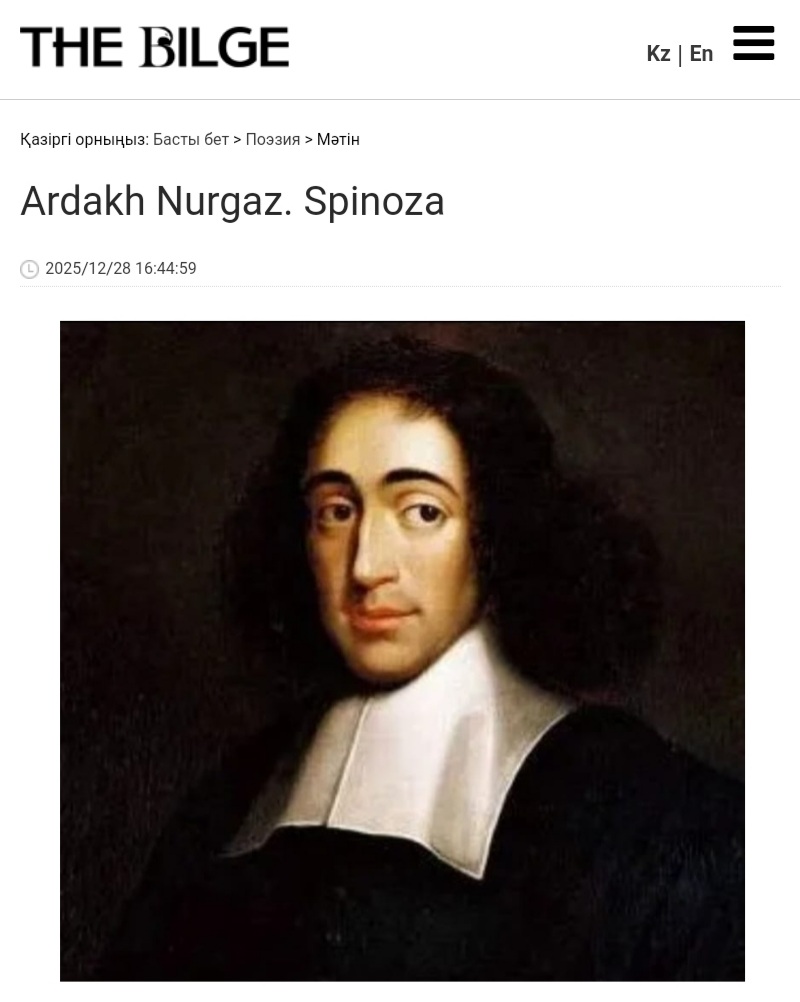
In Ardakh Nurgaz's long poem "Spinoza" (2026), the imagery of "Voices/Sounds" and "The Door" is the core narrative lever and philosophical metaphor of the entire poem.
The poet revealed in his literary self that the poem does not begin by describing Spinoza's life, but rather with a magical realist scene: "I knocked on the door, no one answered, but I heard a cacophony of voices inside..." This detail not only sets the tone for the poem's multidimensional dialogue but also contains profound postmodern poetic imagery:
1. "The Door": The Separation and Conditional Crossing of Subjective Boundaries
In the imagery coordinate system of the poem, the "door" is a two-way separation zone, metaphorically representing the boundary between individual sovereignty (the poet) and absolute reason (Spinoza).
* Physical Rejection and Spiritual Openness: The poet "knocks on the door" but "no one opens it," corresponding to the irreversibility of history, and the extreme closedness and purity of Spinoza's spiritual world as a maverick philosopher, expelled from the Jewish community, grinding lenses in solitude. The closed door signifies that the core of Western rationality cannot be easily entered through simple "factual retelling."
* Breakthrough of the Boundaries of Rationality: But this closed door does not block the poetic. It becomes a "conditional, multi-layered dialogic form." Although the door is closed, it is a "sound-permeable door." It suggests that the isolation of matter is ineffective in the face of the absolute cosmic entity (Substance), and the poet's consciousness penetrates the material barriers of history and space through "hearing."
2. "Sound": Polyphony and the Resonance of Cosmic Attributes
In contrast to the stillness and isolation of the "door," "sound" in the poem is a fluid, complex, and logocentrism-breaking material existence.
* “A cacophony of voices”—the cacophony of history: what comes from inside the door is not Spinoza's monologue, but “a cacophony of voices” (multiple voices/clashes). Nurgaci employs masterful polyphony here: these voices contain the debates of the ancient Greek school, the trials of religious theology, the gossip of the citizens of Amsterdam, and the rustling sound of Spinoza writing his *Ethics* in Latin.
* The intertwining of dual footprints: Nurgaci points out that the voices echoing inside the door possess a dual quality—they belong to both the 17th-century Dutch philosopher and the 21st-century Kazakh poet. This is not the voice of Spinoza alone, but rather the “non-identical traces left in the text” by two souls traversing time and space.
* Sound as an attribute of the universe: If we combine this with Spinoza's philosophy of "God is nature," the "voices" within this door are actually the different "modes" and "attributes" of the universe's unique, infinite entity at the level of thought. The conflict, collision, and discussion of sounds within the door are precisely the invisible melody of all things operating under the laws of nature.
3. Fusion of Imagery: The Sound Art of the "Door" as a Filter
Throughout the poem, the interaction between "door" and "sound" creates a unique semantic space:
【The Dynamic Structure of "Sound and Door"】
[The Poet's Knocking (Subjective Consciousness)] ───► [The Closed Door (Historical/Physical Boundary)]
│ (Isolation and Filtering)
▼
[The True Sound (Rational Echo)] ◄─── [The Noise Inside the Door (Polyphonic Debate)]
* The Purification Process of Sound: The "noise" heard by the poet standing outside the door, filtered through the physical barrier of the "door," gradually transforms into a pure "Imagistic Sound" in the latter half of the poem. The noisy historical noise disappears, replaced by a grand, rational clarity.
* From Inside the Door to the Wilderness (From Sound to Oil Painting and Tulips): The poem begins with a philosophical conflict triggered by "the sound inside the door," and its echoes eventually transcend geographical boundaries, merging with the imagery of Dutch oil paintings and the wild tulips rolling like an ocean in Kazakhstan during spring. The tightly closed "door" is ultimately melted away by the poetic inspiration.
Summary of Appreciation
In Spinoza, the image of "knocking on the door but hearing the sound" is Nurgaci's perfect portrayal of the fate of intellectuals: we can never truly travel back to the past, nor can we fully become philosophers of another civilization (the door is closed); but through the imagination of poetry that transcends reason (hearing the sound), we can lie on the crack of history and experience a spiritual tremor with the greatest souls of mankind.
If you are interested, we can continue to explore the following two derivative topics:
* Exploring how this poem smoothly transitions from the hustle and bustle inside Amsterdam to the visual contrast of tulips blooming on the Kazakh steppe.
* Analyze how Nurgaci specifically uses "hidden inner tension" to maintain the artistic appeal of this long poem.
Which one would you like to choose?
In the long poem [Spinoza], the transition from "the clamor inside the Amsterdam gates" to "the tulips blooming on the Kazakh steppe" is not only a visually striking contrast, but also a "silky dissolution" of geographical, historical, and philosophical symbols meticulously designed by Ardakh Nurgaz.
According to the poet's own account and creative interpretation, this seemingly dramatic leap across time and space is achieved through the following three exquisite artistic steps:
1. Intermediary Bridge: "Visual Stabilization" of Dutch Classical Oil Paintings The poem does not jump directly from the sounds inside the gates to the steppes, but rather uses Dutch classical oil paintings as an intermediate visual medium.
* Sound to Image: The "voices" inside the gates, interwoven with historical, religious, and philosophical debates, gradually settle in the poet's imagination, becoming images of oil paintings in the style of the 17th-century Dutch Golden Age.
* The transition between movement and stillness: Noise is audible and chaotic; while oil painting is silent and solidified. By materializing "sound" into "oil painting," the poem completes a smooth transition from "audible movement" to "visual stillness." The scene before the reader's eyes smoothly unfolds from a closed, noisy wooden door into a European classical portrait or still life painting with a calm tone and full of light and shadow texture.
2. Core code: Ecological intertextuality of "Tulips"
When the reader's gaze falls on the "Dutch oil painting," the iconic visual symbol—the tulip—naturally "grows" out of the painting. This is the most crucial geographical link in the entire poem.
* Misaligned symbiosis of geographical symbols: In most people's perception, tulips are a symbol of the Netherlands. But from the perspective of plant archaeochemistry and ecology, the true origin and gene pool of wild tulips worldwide is the Kazakh steppe and the Tian Shan Mountains.
* The overlap of two footprints: Nurgaz points out that it is the species "tulip" that deeply connects Kazakhstan and the Netherlands. When the image of tulips in the oil painting is awakened, Amsterdam, belonging to the West and rationality, is instantly intertwined with the Kazakh steppe, belonging to the East and nomadic.
3. The ultimate release: from the closed labyrinth to the vast wilderness
After completing the above two steps of preparation, the poem ushered in the most shocking visual explosion - from the narrow, dark, and tightly closed mirror-polishing workshop in Amsterdam in the 17th century, it was instantly pushed open and transformed into an endless sea of red and yellow tulips on the Kazakh steppe.
* The infinite stretch of visual dimensions:
* Inside the door: the space is claustrophobic, oppressive, and full of human rational conflict.
* Steppe: the space is infinite, open, and dominated by nature.
* The poet describes that in two weeks in spring, wild tulips will completely cover the Kazakh steppe, "ripple like a sea". This extreme stretch from a "confined little room" to a "sea of flowers" brings readers a tremendous sense of spiritual liberation.
* A philosophical pantheistic conclusion: This smooth transition precisely echoes Spinoza's philosophical core of "God is Nature" (Deus sive Natura). The fierce debates and sectarian trials (noise) within the confines of the room are merely internal conflicts arising from the limitations of human reason. When the poem finally merges into the surging, ocean-like sea of wild tulips on the Kazakh steppe, independent of anyone's will, [Spinoza's absolute "Substance"] truly reveals itself—nature itself is the highest reason; it is silent, yet contains all noise.
Summary of Appreciation
Ardakh Nurgaz did not rely on awkward switching of geographical terms, but instead used a tight stream of consciousness chain of "sound, oil painting, tulips, grassland flower sea" to stitch together the birthplace of Western rationality with the geographical roots of the East. The ending of this poem allows Spinoza, the lonely Western philosopher, to finally find his ultimate spiritual home of "God is nature" in the spring breeze and flower sea of the Kazakh steppe.
So far, we have explored in depth the grand spatial and temporal aesthetics presented by Ardakh Nurgaz in his long poem. If you wish, we can talk about the following:
阿尔达克·努尔哈兹(Ardakh Nurgaz)在长诗[《斯宾诺莎》("Spinoza", 2026)]中,关于“声音(Voices/Sounds)与门(The Door)”的意象建构,是整首诗最核心的叙事杠杆与哲学隐喻。
诗人曾在文学自述中透露,这首诗的开篇并非描述斯宾诺莎的生平,而是以一个魔幻现实主义的场景切入:“我敲了门,没人开,但我听到里面有嘈杂的说话声……” 这一细节不仅奠定了全诗多维对话的基调,更蕴含了极深的后现代诗学意象: [1]
1. “门”:主体边界的隔离与有条件的跨越
在诗歌的意象坐标系中,“门”是一个双向的隔离带,隐喻着个体主权(诗人)与绝对理性(斯宾诺莎)之间的边界。
* 物理的拒绝与精神的敞开:诗人“敲门”而“无人开门”,对应着历史的不可逆性,以及斯宾诺莎作为一位特立独行、被犹太社群驱逐、孤独研磨镜片的哲学家,其精神世界的极度封闭与纯粹。门紧闭着,意味着西方理性的核心是无法通过简单的“事实复述”来轻易进入的。
* 理性边界的突破:但这扇封闭的门并没有阻断诗意。它变成了一个“有条件的、多层对话的形态”(conditional, multi-layered dialogic form)。门虽然关着,却是一扇“透音的门”。它暗示着物质的隔绝在绝对宇宙实体(Substance)面前是失效的,诗人的意识通过“听觉”穿透了历史与空间的物质阻隔。 [1, 2]
2. “声音”:复调(Polyphony)与宇宙属性的共鸣
相对于“门”的静止与隔绝,“声音”在诗中是流动的、复杂的、打破 logocentrism(理性中心主义)的物质存在。 [3]
* “嘈杂的说话声”—— 历史的众声喧哗:门内传出的不是斯宾诺莎一个人的独白,而是“嘈杂的说话声”(multiple voices/clashes)。努尔哈兹在此运用了高超的复调诗学(Polyphony):这些声音里包含了古希腊学派的辩论、宗教神学的审判、阿姆斯特丹市民的流言,以及斯宾诺莎用拉丁文写下《伦理学》时的沙沙声。
* 双重足迹的交织:努尔哈兹指出,门内回荡的声音具有双重品质——它既属于17世纪的荷兰哲学家,也属于21世纪的哈萨克诗人。这并不是斯宾诺莎一个人的声音,而是两个灵魂在跨越时空时,“在文本中留下的非同质的、交织在一起的足迹(non-identical traces)”。
* 声音即宇宙的属性:如果结合斯宾诺莎“神即自然”的哲学,这门内的“众声”实际上就是宇宙唯一的、无限实体在思维层面的不同“样式(Modes)”和“属性”。声音在门内冲突、碰撞、讨论,正是万物在自然法则下运转的无形旋律。 [1, 3]
3. 意象的交融:“门”作为过滤器的声音艺术
在全诗的推进中,“门与声音”的互动制造出一种独特的语义空间(Poetic Space):
【“声音与门”的动力学结构】
[ 诗人的敲门(主体意识) ] ───► [ 紧闭的门(历史/实体边界) ]
│ (隔离与过滤)
▼
[ 真正的声音(理性的回响) ] ◄─── [ 门内的嘈杂声(复调辩论) ]
* 声音的纯化过程:诗人站在门外听到的“嘈杂声”,通过“门”的物理过滤,在诗歌的后半段逐渐蜕变为一种纯粹的“意象之声(Imagistic Sound)”。嘈杂的历史噪音消失了,取而代之的是宏大的、理性的澄明。
* 从门内走向旷野(从声音走向油画与郁金香):诗歌以“门内的声音”引发的哲学冲突开始,最终其回声跨越地缘,与荷兰的油画、哈萨克春天如海洋般翻滚的野郁金香意象融为一体。紧闭的“门”最终在诗意的感召下被彻底融化。 [1]
鉴赏总结
在《斯宾诺莎》中,“敲门不入却听其声”的意象,是努尔哈兹对知识分子宿命的绝佳写照:我们永远无法真正穿越回过去、无法完全成为另一个文明的哲人(门紧闭着);但通过诗歌那超越理性的想象力(听到了声音),我们却能伏在历史的门缝上,与人类最伟大的灵魂共同经历一场精神的战栗。 [1, 3]
如果你有兴趣,我们可以继续探讨以下两个衍生话题:
* 探讨这首诗是如何从阿姆斯特丹门内的喧嚣,丝滑过渡到哈萨克草原上盛开的郁金香这一视觉反差的。
* 分析努尔哈兹在这首长诗中,如何具体运用“隐藏的内在张力”来保持长诗的艺术吸引力。 [1, 4, 5]
你想选择哪一个?
在长诗[《斯宾诺莎》("Spinoza")]中,从“阿姆斯特丹门内的喧嚣”过渡到“哈萨克草原上盛开的郁金香”,不仅是视觉上的震撼反差,更是阿尔达克·努尔哈兹(Ardakh Nurgaz)精心设计的一场地理、历史与哲学符号的“丝滑消融”。 [1]
根据诗人本人的自述和创作阐释,这种看似剧烈的跨时空跳跃,是通过以下三个精妙的艺术台阶来完成丝滑过渡的:
1. 中介桥梁:荷兰古典油画的“视觉静化”
诗歌并没有从门内的声音直接“蹦”到大草原,而是通过荷兰古典油画(Dutch oil paintings)作为中间视觉媒介。 [1]
* 声音向画面的定格:门内那些由历史、宗教和哲学辩论交织而成的“嘈杂声(Voices)”,在诗人的想象中逐渐沉淀,定格为一幅幅具有17世纪荷兰黄金时代风格的油画。
* 动与静的转换:喧嚣是有声的、混乱的;而油画是无声的、凝固的。通过将“声音”物化为“油画”,诗歌完成了从“听觉的动”到“视觉的静”的平稳过渡。读者眼前的画面从一扇密闭、嘈杂的木门,丝滑地舒展为一幅色调沉稳、充满光影质感的欧洲古典肖像或静物画。 [1]
2. 核心密码:“郁金香”的生态互文
当读者的视线落在“荷兰油画”上时,标志性的视觉符号——郁金香(Tulip)便自然地从画作中“生长”出来。这是整首诗最关键的地缘纽带。 [1]
* 地缘符号的错位共生:在大多数人的认知中,郁金香是荷兰的象征。但从植物考古学和生态学来看,全球野郁金香的真正发源地和基因库,正是哈萨克草原与天山山脉。
* 双重足迹的重合:努尔哈兹指出,正是“郁金香”这一物种,在深层连接着哈萨克斯坦与荷兰。当油画中的郁金香意象被唤醒,属于西方、理性的荷兰阿姆斯特丹,就在一瞬间与属于东方、游牧的哈萨克 steppe(草原)发生了不可分割的物理与宿命交织。 [1]
3. 终极释放:从封闭迷宫到如海旷野
在完成了上述两步铺垫后,全诗迎来了最震撼的视觉爆发——从17世纪那间狭窄、阴暗、房门紧闭的阿姆斯特丹磨镜工作室,瞬间推开,化为了哈萨克草原上无边无际的红黄色郁金香海洋。 [1]
* 视觉维度的无限拉伸:
* 门内:空间是幽闭、压抑、充满人类理性冲突的。
* 草原:空间是无限、开阔、由大自然主宰的。
* 诗人描述道,在春天的两周时间里,野生郁金香会彻底覆盖哈萨克草原,“像海洋一样翻滚(ripple like a sea)”。这种从“幽闭小室”到“花海泛澜”的极限拉伸,带给读者一种精神上的巨大解放感。
* 哲学上的泛神论归宿:
这一丝滑过渡,精准地呼应了斯宾诺莎“神即自然”(Deus sive Natura)的哲学内核。门内的那些激烈辩论、宗派审判(喧嚣),不过是人类由于理性局限而产生的内耗。当诗歌最终融入哈萨克草原那如海洋般汹涌、不为任何人意志而生灭的野郁金香海时,[斯宾诺莎的绝对“实体(Substance)”]真正显现了——大自然本身就是最高的理性,它无声,但包含一切喧嚣。 [1]
鉴赏小结
阿尔达克·努尔哈兹没有依赖生硬的地理名词切换,而是用“声音 $\rightarrow$ 油画 $\rightarrow$ 郁金香 $\rightarrow$ 草原花海”的严密意识流链条,将西方理性的发源地与东方的地缘根骨缝合在了一起。这首诗的结尾,让斯宾诺莎这位孤独的西方哲学家,最终在哈萨克草原的春风与花海中,找到了他那“神即自然”的终极精神归宿。 [1]
至此,我们已经深入探讨了阿尔达克·努尔哈兹在长诗中展现的宏大时空美学。如果愿意,我们接下来可以聊聊:
Ardakh Nurgaz. Spinoza
https://www.thebilge.kz/e/action/ShowInfo.php?classid=5&id=4140
Ardakh Nurgaz. My “Spinoza”
https://www.thebilge.kz/e/action/ShowInfo.php?classid=33&id=4141